Friday, October 6, 2017

Without a survivor


                I heard a story

     With my boat I traveled to many ports,
     and therefore my knowledge rose..
     Almost in every one I heard a story of the place…

     I will mention two of these stories in any case.


     1876. It has become a year of myth and mystery,

                and a landmark in military history…
                (This story was told to me in Seattle)


               The U.S. 7th Cavalry Regiment lost the battle…..

               Custer’s personal command, about 210 soldiers, 
                                                                     [ was wiped out
               (and for this there is no doubt)
               without a survivor to tell the story, to share the details.

                Most were killed by Indian arrows, 

                                                               [(the view which prevails) ..


      480 BC. It has become a year of myth and mystery,

                     and a landmark in military history…
                     (This story was told to me on a tanker T 2 ..
                     The envoy Greek army corps lost the battle, too…..

                     Leonida’s personal command, about 300 soldiers, 
                                                                          [was wiped out.
                    (and for this there is no doubt)
                    without a survivor to tell the story, 
                                                                   [to share the details.

                     Most were killed by Persian arrows, 

                                                         [ (the view which prevails) ..
_____________________________

Texts and Narration: Odysseus Heavilayias - ROTTERDAM //
Language adjustments and text adaptation: Kellene G Safis - CHICAGO//
Digital adaptation and text editing: Cathy Rapakoulia Mataraga - PIRAEUS

Νο: 8
_____________________________________________________________

Battle Of Little Big Horn summary: The battle of Little Bighorn occurred in 1876 and is commonly referred to as “Custer’s Last Stand”. The battle took place between the U.S. Cavalry and northern tribe Indians, including the Cheyenne, Sioux, and Arapaho. Prior to the battle of Little Bighorn in Montana, the tribal armies, under the direction of Sitting Bull, had decided to wage war against the whites for their refusal to stay off of tribal lands in the Black Hills. In the spring of 1876, Sitting Bull and his tribal army had successfully battled the U.S. Cavalry twice.

The U.S. Cavalry was attempting to force the Indians back to their reservations and divided into three columns to attack. One of the columns was led by Lt. General George Custer, who spotted a Sioux camp and decided to attack it. 
However, Indian forces outnumbered his troops three to one, and Custer and his troops were forced to reorganize. While waiting aid from the other Cavalry forces, another group of Indian forces, led by Crazy Horse, effectively trapped Custer and his men. In a desperate attempt to hold off the Indian warriors, Custer ordered his men to short their horses and stack their bodies to form a barricade to protect them from the Indians.
It took less than an hour for the arrows and bullets of the Indians to wipe out General Custer and his men. Despite having won this battle, the Indians were not victorious. Outrage over the death of the popular Custer led the U.S. government to redraw the boundaries of the Black Hills so that the land would not be part of reservation property, which left it open for white men to settle.   source

Persians Attack the Greeks at Thermopylae:   Thermopylae (lit. "hot gates") was a pass the Greeks tried to defend in battle against the Persian forces led by Xerxes, in 480 B.C.
The Spartans who led the defense were all killed, and they may have known in advance that they would be, but their courage provided inspiration to the Greeks.
Spartan King Leonidas  was general in charge of the Greek forces that tried to restrain the vast Persian army, to delay them, and keep them from attacking the rear of the Greek navy, which was under Athenian control
  source  

isos...

Thursday, October 5, 2017

A forbidden love between warring ...


                            Athens  demonstrating
     
           Athens, square of Constitution,
          The heart of every demonstration and revolution…

           Locals call it the Syntagma Square…..
           It was a hot summer when I was there
           the year two thousand and eleven….

           Smoke from Molotovs and tear gas was hiding
                                               [the vault of heaven.

After violent clashes protesters fled,

abandoning demands for work and bread.

Also the police withdrew fast…

I stayed there, I was the last…

   
Standing and gazing at the old palace,
suddenly  a tourist girl, Shannon from Dallas,
(seemed  old time, old fashion)
asked me what was this mansion.

I answered, this building and this square,
is directly connected with love…
                                               …you beware,
because the "winged cupid" preys on.

Eagerly she asked me "please go on".

I told her that this was the palace of a besieged queen ..
(It was like seeing both of us a projection screen)

                 
This beauty, Queen Amalia, was the jewel of the palace,
nicknamed Crown of the North, or Corona Borealis.

In a ball at the royal court, 
she fell in love with a Cavalry Colonel Kallergis, in short….

The  noble origin officer handed his heart without a fight,

in the blueblood queen with the blue eyes and bright ...

They accused her the most sinful of her time.
Unfairly, it was just a platonic* love and not a crime.

                  
    Fate has drawn them apart..
        Duty unfortunately must betray the heart…

        Her beloved Colonel, with his cavalry besieged the palace ..

        He blamed the king Otto for spitefulness and malice ..

       Thousands of people stood by the brave officer ..
       The king pressed on, constitution to offer.

       Although this was the only solution,

       King Otto shouted:  "No Constitution" !
       and ordered his chief-battery, major “Skinas” to open fire.

       The Colonel drew his sword and yelled:  "Constitution Now Sire"*           

       The order of “Skinas” sounded to Otto incomprehensible,
       but for the Greek gunners the order was very understandable ...
       They turned the cannons against the palace and the Κing….

    The Queen mentally said goodbye to Colonel,
                                                            [by kissing his gift, a golden ring….

______________________________________________________________

Texts and Narration: Odysseus Heavilayias - ROTTERDAM //
Language adjustments and text adaptation: Kellene G Safis - CHICAGO//
Digital adaptation and text editing: Cathy Rapakoulia Mataraga - PIRAEUS

Νο: 7
_______________ The above story was inspired by the work of George Roussos "Queen Amalia"   Series "Queen Amalia" written by George Russos  (1975)


Plot:  Fall 1839 in Athens. Long ball of the palace, the Queen Amalia, meets with Colonel Kallergis. 
This meeting is the beginning of a great rapport, which will quickly evolve into love. 
Amalia tries to advise Otto remove their advisors keep him away from the people and their problems and irresolute king subjugated slowly in strong personality, giving the part of his power. 
While in the army but there is resentment over autocratic administration of the Bavarians and Athens popular effervescence, Amalia, 
Series "Queen Amalia" expected with great impatience 
of the television audience.  From the most popular TV programs of the season 1975-1976. The history of the series, in the form of photo-romance, published in the weekly magazine "Maria Lena" for 46 weeks. Is not saved in the file.
________________________________

*  Platonic love,    An emotional and spiritual relationship between a couple that does not involve sexual desire.
*  Sire,  -archaic-  A respectful form of address for someone of high social status, especially a king.
*  Otto, was a Bavarian prince who became the first modern King of Greece in 1832 under the Convention of London. He reigned until his deposition in 1862.
*  Amalia of Oldenburg was queen consort of Greece from 1836 to 1862 as the spouse of King Otto .
As the daughter of Duke Paul Frederick Augustus of Oldenburg (later Grand Duke of Oldenburg), she was born a duchess of  Oldenburg, though that title was never used in Greece.
When she arrived in Greece in 1837, she at first won the hearts of the Greeks with her refreshing beauty. After the Queen became more politically involved, however, she became the target of harsh attacks — and her image suffered further as she proved unable to provide an heir. She and her husband were expelled from Greece in 1862, after an uprising. She spent the rest of her years in exile in Bavaria.
_________

isos...

Wednesday, October 4, 2017

Alerting everyone...

The Runners
         A Historic Coincidence

W
hile was reading the history of Greece,
my dear American friend Clarice,
has found surprisingly, the other day,
(in the July 4 holiday),
that the Greek Marathon victory,
and an event in American history,
had similarities to a point.


     Chronologically of course disjoint,
     but with the same bravery,
     the same ideal, "freedom”, not slavery…..

    __________________


    390 BC,
Phedippides runs....

to warn as many Athenians as he may
that the Persian army is on its way….

He runs through Pallini County,
an offer to his compatriots, a bounty…

Attica, he is alerting everyone…

The Greeks with such brave men won…


       1860 AD,
Paul Revere rides.....

to warn as many Americans as he may,
that the British army is on its way….

He rides through Middlesex County,
an offer to his compatriots, a bounty…

Massachusetts, he is alerting everyone…
                                                The Americans with such brave men won…

__________________________________________________________

* photo post: The Runners, a 16-foot sculpture by Dr. Theodoros Papagiannis, is a piece of art at O’Hare International Airport. Donated by the Athens Committee of Chicago Sister Cities International and supported by Chicago’s large Greek-American community, the work depicts five runners emerging from antiquity into the modern world.  
The installation started in March along I-190 south embankment side. The project was presented in late 2011. In the photo a model of the sculpture (pictured above) is on display at the Terminal 5 arrival hall of the International Airport O'Hare.
________________________________________________

Texts and Narration: Odysseus Heavilayias - ROTTERDAM //
Language adjustments and text adaptation: Kellene G Safis - CHICAGO//
Digital adaptation and text editing: Cathy Rapakoulia Mataraga - PIRAEUS

Νο: 6 ______________________________________________________________


Between 9 and 10 p.m. on the night of April 18, 1775, Joseph Warren told Revere and William Dawes that the king's troops were about to embark in boats from Boston bound for Cambridge and the road to Lexington and Concord. Warren's intelligence suggested that the most likely objectives of the regulars' movements later that night would be the capture of Adams and Hancock.

They did not worry about the possibility of regulars marching to Concord, since the supplies at Concord were safe, but they did think their leaders in Lexington were unaware of the potential danger that night. Revere and Dawes were sent out to warn them and to alert colonial militias in nearby towns


"Paul Revere's Ride" (1860) is a poem by American poet Henry Wadsworth Longfellow that commemorates the actions of American patriot Paul Revere on April 18, 1775,


            ______________ Paul Revere's Ride _________________   

   LISTEN, my children, and you shall hear   
   Of the midnight ride of Paul Revere,
   On the eighteenth of April, in Seventy-five;
   Hardly a man is now alive
   Who remembers that famous day and year.
   He said to his friend, 'If the British march
   By land or sea from the town to-night,
   Hang a lantern aloft in the belfry arch
   Of the North Church tower as a signal light,—
   One, if by land, and two, if by sea;
   And I on the opposite shore will be,
   Ready to ride and spread the alarm
   Through every Middlesex village and farm,
   For the country folk to be up and to arm.'

  Then he said, 'Good-night!' and with muffled oar
  Silently rowed to the Charlestown shore,
  Just as the moon rose over the bay,
  Where swinging wide at her moorings lay
  The Somerset, British man-of-war;
  A phantom ship, with each mast and spar
  Across the moon like a prison bar,
  And a huge black hulk, that was magnified
  By its own reflection in the tide. 

  Meanwhile, his friend, through alley and street,

  Wanders and watches with eager ears,
  Till in the silence around him he hears
  The muster of men at the barrack door,
  The sound of arms, and the tramp of feet,
  And the measured tread of the grenadiers,
  Marching down to their boats on the shore.

  Then he climbed the tower of the Old North Church,
  By the wooden stairs, with stealthy tread,
  To the belfry-chamber overhead,
  And startled the pigeons from their perch
  On the sombre rafters, that round him made
  Masses and moving shapes of shade,—
  By the trembling ladder, steep and tall,
  To the highest window in the wall,
  Where he paused to listen and look down
  A moment on the roofs of the town,
  And the moonlight flowing over all.

  Beneath, in the churchyard, lay the dead,
  In their night-encampment on the hill,
  Wrapped in silence so deep and still
  That he could hear, like a sentinel's tread,
  The watchful night-wind, as it went
  Creeping along from tent to tent,
  And seeming to whisper, 'All is well!'
  A moment only he feels the spell
  Of the place and the hour, and the secret dread
  Of the lonely belfry and the dead;
  For suddenly all his thoughts are bent
  On a shadowy something far away,
  Where the river widens to meet the bay,—
  A line of black that bends and floats
  On the rising tide, like a bridge of boats.

  Meanwhile, impatient to mount and ride,
  Booted and spurred, with a heavy stride
  On the opposite shore walked Paul Revere. 
  Now he patted his horse's side,
  Now gazed at the landscape far and near,
  Then, impetuous, stamped the earth,
  And turned and tightened his saddle-girth;
  But mostly he watched with eager search
  The belfry-tower of the Old North Church,
  As it rose above the graves on the hill,
  Lonely and spectral and sombre and still.
  And lo! as he looks, on the belfry's height
  A glimmer, and then a gleam of light!
  He springs to the saddle, the bridle he turns,
  But lingers and gazes, till full on his sight
  A second lamp in the belfry burns!

  A hurry of hoofs in a village street,
  A shape in the moonlight, a bulk in the dark,
  And beneath, from the pebbles, in passing, a spark
  Struck out by a steed flying fearless and fleet;
  That was all! And yet, through the gloom and the light,
  The fate of a nation was riding that night;
  And the spark struck out by that steed, in his flight,
  Kindled the land into flame with its heat.

  He has left the village and mounted the steep,
  And beneath him, tranquil and broad and deep,
  Is the Mystic, meeting the ocean tides;
  And under the alders that skirt its edge,
  Now soft on the sand, now loud on the ledge,
  Is heard the tramp of his steed as he rides.

  It was twelve by the village clock,
  When he crossed the bridge into Medford town.
  He heard the crowing of the cock,
  And the barking of the farmer's dog,
  And felt the damp of the river fog,
  That rises after the sun goes down.

  It was one by the village clock,
  When he galloped into Lexington.
  He saw the gilded weathercock
  Swim in the moonlight as he passed,
  And the meeting-house windows, blank and bare,

  Gaze at him with a spectral glare,
  As if they already stood aghast
  At the bloody work they would look upon.

  It was two by the village clock,
  When he came to the bridge in Concord town.
  He heard the bleating of the flock,
  And the twitter of birds among the trees,
  And felt the breath of the morning breeze
  Blowing over the meadows brown.
  And one was safe and asleep in his bed.
  Who at the bridge would be first to fall,
  Who that day would be lying dead,
  Pierced by a British musket-ball.

  You know the rest. In the books you have read,
  How the British Regulars fired and fled,—
  How the farmers gave them ball for ball,
  From behind each fence and farm-yard wall,
  Chasing the red-coats down the lane,
  Then crossing the fields to emerge again
  Under the trees at the turn of the road,
  And only pausing to fire and load. 

  So through the night rode Paul Revere;

  And so through the night went his cry of alarm
  To every Middlesex village and farm,—
  A cry of defiance and not of fear,
  A voice in the darkness, a knock at the door
  And a word that shall echo forevermore!
  For, borne on the night-wind of the Past,
  Through all our history, to the last, 
  In the hour of darkness and peril and need,
  The people will waken and listen to hear
  The hurrying hoof-beats of that steed,

  And the midnight message of Paul Revere.
  ___________________________________


 isos...

Tuesday, October 3, 2017

An "ETA" which delayed twenty three centuries


B.C. Pytheas beyond the "Borders of the Known World"


The estimated time of arrival or ETA is a measure of
when a ship is expected to arrive at a certain place. 

      PROLOGUE 

      "……. have reached these lands but newly
       From an ultimate dim Thule –"

Edgar Allan Poe's poem "Dream-Land"
referred “Thule”,
                    [a secret that can not stand….
________________

We weighed anchor at dawn,
a bunch of sullen sailors,              
               [whose luck has gone.

Propeller begins to revolve,
like the problems,
                       [I can't solve...

Agitated the sea,
              [and agitated my soul,
as we depart for "Thule",
       [close to the northern pole.

While the Atlantic
                      [was furiously beating us,
a sailor... tipsy; boozed; inebriated,
                                    [an old old cuss,
who never and with no one,
                                        [ever discuss,
says this part of the world
                   [in which we go is cursed,
and risks are
                   [everywhere interspersed.
there is never a dawn
             [and the sun never comes up.

Only in the summer
    [it comes out, says drunk cheer up,
and forget it.......... going down for long,
scary place, the explorer Pytheas
                                        [wasn’t wrong
when he decided Thule's location
                              [to remain unknown,
and for us, the future sailors,
                                  [a restricted zone…


Goethe, in "The King in Thule"
             [was mentioned in this unknown land,
he understood why this land..... is banned......

Our ship tames the wild sea,
and the pilot,
           [holding a cup of tea,
get us in the harbor
                         [cursing everyone.

We stayed a month,
           [never once did set the sun...
___________________________________

Texts and Narration: Odysseus Heavilayias - ROTTERDAM // 
Language adjustments and text adaptation: Kellene G Safis - CHICAGO//
Digital adaptation and text editing: Cathy Rapakoulia Mataraga - PIRAEUS

Νο: 5
______________________________________________________________


*  Pytheas,   Greek explorer. P. is the first to have written of Thule, doing so in his now lost work, On the Ocean, after his travels between 330 BC and 320 BC. He supposedly was sent out by the Greek city of Massalia to see where their trade-goods were coming from.

A local stamp of Greenland 1936, inscribed Thule.
Thule (/ˈθjuːliː/; Greek: Θούλη, Thoúlē), also spelled Thula, Thila, or Thyïlea, is, in classical European literature and maps, a region in the far north. Though often considered to be an island in antiquity, modern interpretations of what was meant by Thule often identify it as Norway, an identification supported by modern calculations. 

Other interpretations include Orkney, Shetland, and Scandinavia. In the Late Middle Ages and Renaissance, Thule was often identified as Iceland or Greenland. Another suggested location is Saaremaa in the Baltic Sea. The term ultima Thule in medieval geographies denotes any distant place located beyond the "borders of the known world". Sometimes it is used as a proper noun (Ultima Thule) as the Latin name for Greenland when Thule is used for Iceland.

* "The King in Thule" is a German poem by Johann Wolfgang Goethe used it later 

in his tragedy Faus
_____________


 isos... 

Monday, October 2, 2017

The First Naval Strike


          The First Naval Strike 


          Μany were seen by my eyes,
          waves like mountains, oversize,
          distant seas and foreign skies,
          which of course was not wise,
          bringing me pain and lots of tears .....

          Many were heard by my ears,
          heard in boats and in the piers,
          in Seattle or in Algiers,
          at Yokohama or at Tangiers……

          A lifetime in the ships, I' ve heard many stories
          about wars and the glories,
          about workers struggles and strikes,
          which every ruler of course dislikes….

         The biggest surprise was when I heard
          that the first strike in the history is referred
          to the time of war against the Persians, before Christ..

          Ιn the opinion of the sailors, the wages did not suffice…
          They went on strike and left their ships,
          stating "we do not work for tips."

          Athens, city and state at the same time,
          proposed a salary increase and overtime…

          Finally an agreement, eight drachmas in a lump sum ...
          In a few minutes they heard the drum,
          which was giving rhythm at triremes,
          proving that undoubtedly all times,
          "money can move mountains", and yes,
          I paraphrase the Nat King Cole,*  is correct 
                                                              your guess..              *Faith can move mountains


          Flying in masts, flags and Banners of the first Republic in history,
          defeated the barbarians, but it has remained a mystery
          who inspired the first strike on earth,
          the death of the exploitation, and the strike birth.
_____________________________________

Texts and Narration: Odysseus Heavilayias - ROTTERDAM //
Language adjustments and text adaptation: Kellene G Safis - CHICAGO//
Digital adaptation and text editing: Cathy Rapakoulia Mataraga - PIRAEUS

* item 4
______________________________________________________________

* This poem is based on the historical book "The Building of Democracy", by author Angelos S. Vlachos.page 55: 

 "Aristotle in 23 of the "Athenian State" says the Supreme Court who had implicitly recognized as supreme authority, distributed to each member of the crew of the ships of 8 drachmas, to agree to embark in the ships"

The Battle of Salamis was fought between an Alliance of Greek city-states and the Persian Empire in September 480 BCE, in the straits between the mainland and Salamis, an island in the Saronic Gulf near Athens. It marked the high-point of the second Persian invasion of Greece which had begun in 480 BCE.

To block the Persian advance, a small force of Greeks blocked the pass of Thermopylae, 

300 Spartan. After the loss at Thermopylae, the Allies prepared to defend the Isthmus of Corinth while the fleet was withdrawn to nearby Salamis Island.

The Greek fleet formed in line and scored a decisive victory, sinking or capturing at least 300 Persian ships. Afterwards the Persian made no more attempts to conquer the Greek mainland. A number of historians believe that a Persian victory would have hamstrung the development of Ancient Greece, and by extension western civilization, and this has led them to claim that Salamis is one of the most significant battles in human history.


 isos...

Sunday, October 1, 2017

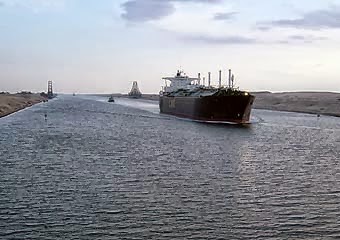
The channel of the Olympian Zeus


Suez i.e. zeuS
(Port) Said i.e. diaS        

                     The Egyptian pilot, a good old pal,
                     was telling me, that centuries 

                                                      [before the canal,
                     the Argonauts to a date
                     with world history's gate,
                     once sailed the Black Sea,
                     then through two rivers maybe three,
                     arrived in the Gulf of heat,
                     ie Persian, having great conceit ....

The hot air burns the sailors face,
actually a cursed place,
but the hot air inflates the sails
and sailing through pristine water trails,
circumnavigate Arabia coast after coast..

Guide and helmsman, the Zeus ghost….

                      Somewhere in the Red Sea
                      God drops the anchor and sailors see
                      that they are in an unfamiliar port……

After thanking Zeus for the support,
and wondering what was the name of that salvation port,
(a name incomprehensible and abstruse)
drank wine and all went on the loose…

                      Next morning, begin to cross the desert, pussyfoot
                      (savage tribes around), they walk ragged, barefoot…

__________________


In this illegible name port, centuries later,
                                        [a gay swart,

with white robe, and very short,
says to some sailors and I, that in the East,


people start reading from the right, 

                                                 [and to release

the meaning of the word Suez(canal)
says "just read eastern-way pal.”


                 In Port Said reaches our boat.
                 Guess what immediately, I wrote?
                 Starting from the right, the name Said.

                 Result "Dias", Zeus himself, 
                                                        [straight or upside…


Rivers begin from Black Sea, uniting with the Euphrates and 
emptying into the Persian Gulf….

_________________________________________________________________

Texts and Narration: Odysseus Heavilayias - ROTTERDAM //
Language adjustments and text adaptation: Kellene G Safis - CHICAGO//
Digital adaptation and text editing: Cathy Rapakoulia Mataraga - PIRAEUS

item 2 
______________________________________________________


Arabs :     Unlike us, the Arabs write from right to left ...

Zeus ie Días :    is the "Father of Gods and men" who rules the Olympians of Mount Olympus as a father rules the family according to the ancient Greek religion. He is the god of sky and thunder in Greek mythology.

The Argonauts :  (Ancient Greek: Ἀργοναῦται, Argonautai) were a band of heroes in Greek mythology, who in the years before the Trojan War, accompanied Jason to Colchis in his quest to find the Golden Fleece. Their name comes from their ship, the Argo, named after its builder, Argus. "Argonauts" literally means  "Argo sailors"..
__________________________________


The city of Suez was known in ancient Egypt as it was used to secure the mining activities in Sinai and to prevent any foreign attacks coming from Palestine or Syria to enter Egypt.

It was normal that Egypt, since ancient times, would have a town in the Northern edge of the Suez Gulf.

Suez has remained as a small peaceful town until the 19th century and it served as a port connecting Egypt with Sinai and the Arabian Peninsula. The city had a population of around 3000 or 4000 inhabitants in 1860.

Everything changed in the city with the beginning of the digging of the Suez Canal as the population increased with very high rates in a limited period of time with so many workers emigrating from different Egyptian cities to come and work in the Suez Canal.

With the establishment of the Railway line, at the end of the 20th century, connecting Suez with the rest of the cities located on the Suez Canal and with Cairo, the Egyptian Capital, the city even developed and flourished like it never did before and it turned out to become an important industrial and commercial center on the Red Sea.         wikipedia


 isos...