Tuesday, September 26, 2017

Have a history teacher explain this... this

History Mystery


Two Views

       Have a history teacher explain this....  if they can. 

Abraham Lincoln was elected to Congress in 1846.
John F. Kennedy was elected to Congress in 1946.

Abraham Lincoln was elected President in 1860.
John F. Kennedy was elected President in 1960.

Both were particularly concerned with civil rights.
Both wives lost their children while living in the White House.

Both Presidents were shot on a Friday.
Both Presidents were shot in the head

Now it gets really weird...

Lincoln 's secretary was named Kennedy.
Kennedy's Secretary was named Lincoln .

Both were assassinated by Southerners.
Both were succeeded by Southerners named Johnson.

Andrew Johnson, who succeeded Lincoln, was born in 1808..
Lyndon Johnson, who succeeded Kennedy, was born in 1908.

John Wilkes Booth, who assassinated Lincoln, was born in 1839.
Lee Harvey Oswald, who assassinated Kennedy, was born in 1939.

Both assassins were known by their three names.
Both names are composed of fifteen letters.

Now hang on to your seat...

Lincoln was shot at the theater named 'Ford'.
Kennedy was shot in a car called ' Lincoln ' made by 'Ford'.

Lincoln was shot in a theater and his assassin ran and hid in a warehouse.
Kennedy was shot from a warehouse and his assassin ran and hid in a theater.

Booth and Oswald were assassinated before their trials.
_________________________________________________
source:
TRIPLE COINCIDENCE ON A SIMPLE $20 BILL, Lisa Matthews
https://books.google.gr/books? isbn=1329409604

_____________________________________________________   No 29

* Snopes presented a point-by-point refutation of these similarities.

The complete take-down is here, but below are some highlights:


Snopes also points out that there is no record of Lincoln having a secretary named Kennedy.
The list has been subject to mockery by one of Harvard's farcical Demon Magazine which included amazing similarities between the two Presidents such as "When Kennedy was shot, the car he was riding in was a Lincoln. Lincoln's last name was Lincoln," and "Both men (except Kennedy) were born in log houses."
Despite the fact-checking and mockery, the "coincidence" list refuses to die.
One reason may be what Scientific American's “Michael Shermer calls "patternicity,” or people's tendency of finding "meaningful patterns in meaningless noise."
Shermer argues that humans are evolutionarily predisposed to looking for patterns in our environment. Our ancestors were those who were most successful at seeing real patterns and adapting to them, but this also means we're more likely to think we recognize patterns where none exist.
Perhaps this is what's happening when people are amazed by these Lincoln-Kennedy coincidences. They may at first seem meaningful, but, as Snopes argues, under closer inspection they don't speak to any meaningful patterns.
CORRECTION: An earlier version of this story gave the incorrect name of the 35th president. It is John F. Kennedy, not John Kennedy, Jr.


 isos...

Monday, September 25, 2017

Matt Damon explores Greek crisis as Jason Bourne...


Bourne legacy, a missed opportunity for Greek movie industry… 

heads to Tenerife (pics)

Neighboring countries may be cashing in on lucrative Hollywood deals with big budgets and international stars, but Greece is turning them away. Producers of the fifth installment of the Bourne spy series starring Matt Damon abandoned Greece as a possible location for the film, choosing instead to transform Tenerife into Athens.

Rather than get authentic anti-austerity rallies, Spain’s Canary Islands were transformed with fake Greek signage, fake Greek graffiti and fake billboards!

Producers chose to depict Greece in locations at the Canary islands because Greece doesn’t extend tax breaks for locally-filmed productions. Nikos Xydakis, Greece’s former culture minister, told private SKAI TV that that tax breaks that draw productions to other countries don’t exist in Greece. He said that draft legislation paving the way for foreign blockbusters was cut short when former Radical Left Coalition PM A. Tsipras resigned.

Matt Damon and Julia Stiles – supposedly in Greece – will be hiring extras from Tenerife. For six weeks, they will spend money in Spanish hotels and use Spanish services – not Greek!


_______________________________________________________  No 28

another story HERE

isos...

Sunday, September 24, 2017

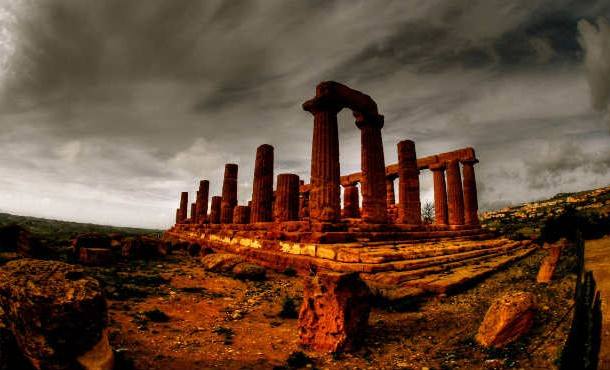
Akragas, Modern Italy


Akragas, Modern Italy

 Nowadays Agrigento is a small city in Sicily that is known for its archaeological legacy, since the city has some of the best ancient ruins and sites in southern Italy thanks to its glorious past. The city, named Akragas, was established around 580 BCE by Greek colonists from Gela, another former Greek colony in what is now southern Italy. 
The city was one of the most dominant, prominent cities of Magna Graecia which translates as “Great Greece,” and was the term ancient Greeks used to refer to all the colonies and coastal areas of southern Italy during Greece’s golden age. Akragas was for many years a financial and cultural center with an extremely large population and great wealth.

By taking a look at the world map today you would never believe that Greece, which is nothing but a small country, currently known as a beautiful tourist destination in southern Europe, had once dominated and colonized most parts of the then-known world. 
For those who love history though, Greece is without a doubt one of the most significant and influential nations of all time with amazing contributions to human culture including philosophy, various sciences, architecture, the Olympic Games, and democracy just to name the most prominent few.

The culture and spirit of Greece had once conquered major parts of modern Europe, the Middle East, Asia, and Africa through the empires and colonies built by different Greek city-states notably Athens, Miletus, Ionia, Knossos, Corinth, and the kingdom of Macedon (not to be confused with the recently formed Slavic country in the Balkans).
______________________________________________________  No 27


isos...

Saturday, September 23, 2017

Texas Revolution....Battle of Gonzales.....Molon labe


 ''Molon labe'' (Greek: μολὼν λαβέ), meaning "come and take them", is a classical expression of defiance. 


   When the Persian armies demanded that the Greeks surrender their weapons at the Battle of Thermopylae, King Leonidas I responded with this phrase.


''Molon labe'' has been repeated by many generals and politicians in order to express an army's or nation's determination not to surrender.
 
   
   The motto ΜΟΛΩΝ ΛΑΒΕ is on the emblem of the Greek First Army Corps, and is also the motto of United States Special Operations Command Central (SOCCENT). 
   The expression "Come and take it" was a slogan in the Texas Revolution.

The first military engagement
of the Texas Revolution


   The Battle of Gonzales was the first military engagement of the Texas Revolution. It was fought near Gonzales, Texas, on October 2, 1835, between rebellious Texian settlers and a detachment of Mexican army troops.

   In 1831, Mexican authorities gave the settlers of Gonzales a small cannon to help protect them from frequent Comanche raids. 
   Over the next four years, the political situation in Mexico deteriorated, and in 1835 several states revolted. As the unrest spread, Colonel Domingo de Ugartechea, the commander of all Mexican troops in Texas, felt it unwise to leave the residents of Gonzales a weapon and requested the return of the cannon.
   When the initial request was refused, Ugartechea sent 100 dragoons to retrieve the cannon. The soldiers neared Gonzales on September 29, but the colonists used a variety of excuses to keep them from the town, while secretly sending messengers to request assistance from nearby communities. Within two days, up to 140 Texians gathered in Gonzales, all determined not to give up the cannon. 
   On October 1, settlers voted to initiate a fight. Mexican soldiers opened fire as Texians approached their camp in the early hours of October 2. After several hours of desultory firing, the Mexican soldiers withdrew.

   Although the skirmish had little military significance, it marked a clear break between the colonists and the Mexican government and is considered to have been the start of the Texas Revolution. 
   News of the skirmish spread throughout the United States, where it was often referred to as the "Lexington of Texas". The cannon's fate is disputed. It may have been buried and rediscovered in 1936, or it may have been seized by Mexican troops after the Battle of the Alamo.
______________     No 26


isos...

Friday, September 22, 2017

Beneath the World as we Know it


   If you are from the Midwest or upper East coast and middle aged, chances are you spent your summer vacation on the Gulf Coast of Florida back in the 70s like myself. You also probably forgot about being dragged to this place by your parents as I did. 
   Now as a adult, I have been to Greece with visits to many of its small islands and in seeing both, this would be a copy of copy of a copy but the slight atmosphere is still here nonetheless. You have two important contributing factors, the people and the shops as it seems both have been here since before you or I were born yet they retain their colorful charm.

   For those of you not familiar with Tarpon Springs, this was one of those common kitschy tourist towns before the Interstate Highway system was built but somehow manages to hang in there as a extreme rarity. 
   This is one of three distinct sites of similar but rare enjoyment in Florida, the other two being "Johns Pass Village" in Madeira Beach (just South of Tarpon Springs) and "Old Town" in Kissimmee (just outside Walt Disney World). I strongly encourage people to take their families to these three places in Florida as it is that "kitschy" retro feeling of these places that your family will remember more than the common Florida tourist attractions.


Tarpon Springs, Florida

   Tarpon Springs is a city in Pinellas County, Florida, United States. The population was 23,484 at the 2010 census. Tarpon Springs has the highest percentage of Greek Americans of any city in the US. 

 
   The region, with a series of bayous feeding into the Gulf of Mexico, was first settled by white and black farmers and fishermen around 1876. Some of the newly arrived visitors spotted tarpon jumping out of the waters and so named the location Tarpon Springs.

   A few Greek immigrants arrived in this city during the 1890s to work in the sponge industry.
   In 1905, John Cocoris introduced the technique of sponge diving to Tarpon Springs and recruited divers and crew members from Greece. 

   
   The first divers came from the Saronic Gulf islands of Aegina and Hydra, but they were soon outnumbered by those from the Dodecanese islands of Kalymnos, Symi and Halki. 
   The sponge industry soon became one of the leading maritime industries in Florida and the most important business in Tarpon Springs, generating millions of dollars a year. 
 
   When a red tide algae bloom occurred in 1947, wiping out the sponge fields in the Gulf of Mexico, many of the sponge boats and divers switched to fishing and shrimping for a livelihood and others left the business. 

   However, the sponges eventually recovered and there has remained a consistent but smaller sponge industry. 

   In the 1980s, the sponge business experienced a boom due to a sponge disease that killed the Mediterranean sponges. Today there is still a small active sponge industry. 

   Visitors can often view sponge fishermen working at the Sponge Docks on Dodecanese Boulevard. 
   In addition, visitors can enjoy shops, restaurants, and museum exhibits that detail Tarpon Springs' Greek heritage.

   In 2007 and 2008, the City of Tarpon Springs established Sister City relationships with Kalymnos, Halki, Symi, and Cyprus, honoring the close historical link with these Greek islands.


The 1953 film Beneath the 12-Mile Reef, depicting the sponge industry, takes place and was filmed in Tarpon Springs.

______________ No 25


isos...

Thursday, September 21, 2017

The Last of the Greeks


Philopoemen 
at Louvre Museum, Paris

Miltiades was the first, and Philopoemen the last benefactor to the whole of GREECE,

Son of Craugis, of Megalopolis in Arcadia, was one of the few great men that Greece produced in the decline of her political independence. 
His contemporaries looked up to him as the greatest man of their day, and succeeding ages cherished his memory with deep veneration and love. 

   Thus we find Pausanias saying (8.52.1), that Miltiades was the first, and Philopoemen the last benefactor to the whole of Greece, and an admiring Roman exclaiming, "that he was the last of the Greeks" (Plut. Phil. 1). 
   The great object of Philopoemen's life was to infuse among the Achaeans a military spirit, and thereby to establish their independence on a firm and lasting basis. 
   To this object he devoted all the energies of his mind; and he pursued it throughout his life with an enthusiasm and perseverance, which were crowned with far greater success than could have been anticipated, considering the times in which he lived. 
   His predecessor Aratus, who was the founder of the Achaean league, was a man of little military ability, and had chiefly relied on negotiation and intrigue for the accomplishment of his objects and the extension of the power of the league. 
   He had accordingly not cared to train a nation of soldiers, and had in consequence been more or less dependent upon Macedonian troops in his wars with Sparta and other enemies, thereby making himself and his nation to a great extent the subjects of a foreign power. 
   Philopoemen, on the contrary, was both a brave soldier and a good general; and the possession of these qualities enabled him to make the Achaean league a really independent power in Greece.

   Philopoemen was a skilled Greek general and statesman, who was Achaean strategos on eight occasions. From the time he was appointed as strategos in 209 BC, Philopoemen helped turn the Achaean League into an important military power in Greece.
   Was educated by academic philosophers Ecdemus and Demophanes.  Both were Megapolitans, who had helped to depose previous tyrants of Megalopolis, Sicyon and Cyrene. Thus, he was inculcated with notions of freedom and democracy. 
   Philopoemen strove to emulate the 4th-century BC Theban general and statesman, Epaminondas. Philopoemen believed that as a public servant, personal virtue was at all times a necessary condition. So Philopoemen wore humble garments for the rest of his life, spurning any expensive adornments.

    After the battle of Megalopolis Philopoemen first came to the attention of key Greek politicians when he helped defend Megalopolis against the Spartan king Cleomenes III in 223 BC. 
   Cleomenes III had seized Megalopolis. Philopoemen was amongst the first defending the city. During the battle, Philopoemen lost his horse and he was wounded. 
   Nevertheless he remained involved in the battle until the end. His actions helped give the citizens of Megalopolis enough time to evacuate the city.

   The king of Macedonia, Antigonus III Doson was keen to restore Macedonian influence in the Peloponnese for the first time in almost two decades. 
   In 224 BC, he signed an alliance with the Achaeans, Boeotians, Thessalians and the Acarnanians. With his rear secured by treaties, Antigonus invaded the Peloponnese and drove the Spartans out of Argos, taking Orchomenus and Mantineia in the process.
   When he advanced against Laconia, however, Antigonus found that Cleomenes had blocked all the mountain passes except for one. It was there, near Sellasia, that Cleomenes waited with his army.
   Philopoemen commanded a cavalry force, which included soldiers from Megalopolis. He was supported by Illyrian infantry. 
   When the latter entered into the battle, they were surrounded by the enemy. So Philopoemen launched his own attack. While his forces suffered many casualties, the surprised Spartan forces fled. 
   In the encounter, Philopoemen's horse fell and he was wounded by a javelin. Yet he continued to fight behind the enemy's lines.
   In the end the Spartan forces were massacred by the Macedonians and their allies and Cleomenes was forced to flee to Egypt. As the leader of the Achaeans, Philopoemen’s actions impressed Antigonus III.
   He subsequently spent 10 years from 221 BC in Crete as a mercenary captain. Returning to mainland Greece in 210 BC, Philopoemen was appointed commander of the cavalry in the Achaean League.

   In the same year, in one of the battles associated with the First Macedonian War between Macedonia and the Roman Republic, Philopoemen faced Damophantus, whose army was composed of Aetolians and Eleans, near the Larissa river (on the border of Elis). 
   During the battle, Damophantus charged directly against Philopoemen with his spear. Bravely, Philopoemen didn't retreat, but waited with his lance, which he mortally thrust into Damophantus' chest. Immediately, the enemy fled from the battlefield. By this action, Philopoemen’s fame increased across Greece.

   Philopoemen was appointed strategos of the Achaean League in 209 BC. Philopoemen used his position to modernise and increase the size of the Achaean army and updated the soldiers’ equipment and battle tactics.
   His efforts to make the Achaeans an effective fighting force bore fruit a couple of years later.

   In the years following the defeat of the Spartan king Cleomenes III at the Battle of Sellasia, Sparta experienced a power vacuum that eventually led to the Spartan kingship being bestowed on a child, Pelops, for whom Machanidas ruled as regent.

    The Battle of Mantinea was fought in 207 BC between the Spartans led by Machanidas and the Achaean League, whose forces were led by Philopoemen. 
   The Achaeans defeated the Spartans. In the battle, Philopoemen defeated and killed the Spartan ruler Machanidas in one-on-one combat. 
   Afterward, the Achaeans erected at Delphi a bronze statue which captured the fight between Machanidas and Philopoemen.
   With his victory at Mantinea, Philopoemen was able to go on to capture Tegea, and then move with his army as far as the Eurotas River.

   Following Machanidas' death, Nabis, a Syrian sold into slavery, rose to power in Sparta and became the new regent for Pelops. Nabis soon overthrew Pelops. Under Nabis, Sparta continued to trouble the Peloponnese.

   In 205 BC, Philip V of Macedon made a temporary peace (the Peace of Phoenice) with Rome on favourable terms for Macedonia thus ending the First Macedonian War. 
   After the Peace, Nabis went to war against the Achaean League. However, Philopoemen was able to expel Nabis from Messene.
   Philopoemen was appointed strategos for the Achaean League between 201 and 199 BC.

   In 201 BC, Nabis invaded and captured Messene. However, the Spartans were forced to retreat when the Achaean League army under Philopoemen intervened. 
   Nabis' forces were decisively defeated at Tegea by Philopoemen and Nabis was forced to check his expansionist ambitions for the time being.

   The Cretan city of Gortyna then asked for Philopoemen’s help. So in 199 BC Philopoemen returned to Crete again as a mercenary leader. Philopoemen had to change his tactics as the fighting on the island was more in the style of guerrilla warfare. Nonetheless, with Philopoemen’s experience, he was able to defeat his enemies. Philopoemen spent six years in Crete.
   In the meantime, Nabis took advantage of Philopoemen's absence, laying siege to Megalopolis for a lengthy period. Nabis also acquired the important city of Argos from Philip V of Macedon, as the price of his alliance with the Macedonians. 
   Nabis then defected to the Romans in the expectation of being able to hold on to his conquest.

   In 196 BC, Roman general and pro-consul Titus Quinctius Flamininus accused the Spartan ruler, Nabis, of tyranny, took Gythium in Laconia and forced Nabis to surrender Argos. 
   After checking the ambitions of the Spartan tyrant, Nabis, the Roman forces under Flamininus withdraw in 194 BC from Greece. 
   With the Romans no longer having a military presence in Greece, the dominant powers in the region were the kingdom of Macedon, the Aetolians, the strengthened Achaean League and a weakened Sparta. 
   The Aetolians, who had opposed the Roman intervention in Greek affairs, incited the Spartan leader, Nabis, to retake his former territories and regain his influence in Greek affairs.
   Returning to the Greek mainland as strategos in 193 BC, Philopoemen was appointed strategos for a second time to lead the fight against Nabis.

   In 192 BC, Nabis attempted to recapture the Laconian coastline. The Achaeans responded to Sparta’s renewed interest in recovering lost territory by sending an envoy to Rome with a request for help. In response, the Roman Senate sent the praetor Atilius with a navy, as well as an embassy headed by Flamininus.

   Not waiting for the Roman fleet to arrive, the Achaean army and navy headed towards Gythium under the command of Philopoemen. The Achaean fleet under Tiso was defeated by the Spartan fleet. On land, the Achaeans were unable to defeat the Spartan forces outside Gythium and Philopoemen retreated to Tegea.

   When Philopoemen re-entered Laconia for a second attempt, his forces were ambushed by Nabis, but nevertheless Philopoemen managed to gain a victory over the Spartan forces. Philopoemen’s plans for capturing Sparta itself were put on hold at the request of the Roman envoy, Flaminius, after his arrival in Greece. In return, Nabis decided, for the moment, to accept the status quo.

   Nabis then appealed to the Aetolians for help. They sent 1,000 cavalry to Sparta under the command of Alexamenus. However, the Aetolians murdered Nabis and temporarily occupied Sparta. 
   The Aetolian troops seized the palace and set about looting the city, but the inhabitants of Sparta were able to rally and forced them leave the city.

   But Philopoemen took advantage of the Aetolian treachery and entered Sparta with his Achaean army. Now in full control of Sparta, Philopoemen forced Sparta to become a member state of the Achaean League.

   Sparta's entry into the league raised the problem of how to deal with all of the Spartans exiled by the social-revolutionary regimes that had dominated Sparta for a number of years. Philopoemen wanted to restore only those Spartans who were willing to support the league. This meant that he adopted an uncompromising hostility to traditional Spartan concerns.

   In 188 BC, Philopoemen entered northern Laconia with his army and a group of Spartan exiles. His army demolished the wall that the former tyrant of Sparta, Nabis, had built around Sparta. 
   Philopoemen then restored Spartan citizenship to the exiles and abolished Spartan law and its education system, introducing Achaean law and institutions in their place. Sparta's role as a major power in Greece ended, while the Achaean League became the dominant power throughout the Peloponnese.

   These actions provoked opposition even from Philopoemen’s supporters in Sparta. As a result, his opponents in Sparta appealed directly to the Roman Senate, which repeatedly suggested solutions to the disagreements, all of which Philopoemen and his supporters rejected. In fact, Philopoemen and his supporters refused to recognise any Roman role in Achaean internal affairs as they argued that Rome had previously recognised the Achaean League’s independence through a formal treaty.

   This aggressive attitude towards Sparta and towards Rome split Achaean politics. However, Philopoemen died before these matters were resolved.

   In 183 BC, Dinocrates, who strongly opposed Philopoemen, encouraged Messene to revolt against the League. After Dinocrates announced that he would capture Colonis, Philopoemen decided that he needed to subdue the rebellion.

   In the ensuing battle, Philopoemen found himself behind the enemy's lines and was captured by the Messeneans after his horse threw him. He was then invited to drink poison to allow him to have what was then regarded as an honourable death.
   On hearing of his death, the members of the Achaean League joined forces to capture Messene.
   With his death, Philopoemen's body was cremated. At his public funeral, the historian Polybius carried the urn with Philopoemen's ashes and later wrote a biography and defended his memory in his Histories. 
   Pausanias wrote that after Philopoemen's death, 'Greece ceased to bear good men'. 
___________________     No 24

   Sources:
Polybius' Histories (x–xxiii) is the chief authority on the life of Philopoemen. These and a special treatise on Philopoemen (now lost) were used by Plutarch "Philopoemen", Pausanias (viii. 49SI), Livy (xxxi–xxxviii), and indirectly by Justin (xxx–xxxiv). 
Plutarch, The Lives, "Philopoemen" 
Polybius, The Histories of Polybius, Books X–XXXIII 
Junianus Justinus, Marcus Junianus Justinus, Epitome of the Philippic History of Pompeius Trogus, Books XXX–XXXIV 
The Oxford Classical Dictionary (1964) 
The Oxford History of the Classical World (1995) 
The Oxford Who's Who in the Classical World (2000)


isos...

Wednesday, September 20, 2017

..to The Women of Paris: The Greeks, Born to be Liberal


 The Greek Heroine
...to the women of Paris
"The Greeks, born to be liberal, will owe their independence
only to themselves. So I don't ask your intervention to force
your compatriots to help us.  But only to change the idea of
sending help to our enemies.   The war spreads the horrible

 death..." 
      Manto Mavrogenous

      A rich woman, she spent all her fortune for the Hellenic cause. Under her encouragement, her European friends contributed money and guns to the revolution. 
   Was a Greek heroine of the Greek War of Independence. Manto Mavrogenous (Greek: Μαντώ Μαυρογένους) (1796 - July 1848)  

   She was born in Trieste, then in the Austrian Empire, now part of Italy. Manto was daughter of the merchant and member of the Filiki Eteria, Nikolaos Mavrogenes, and Zacharati Chatzi Bati.    One of her ancestors, the great-uncle of her father, Nicholas Mavrogenes, was dragoman of the Ottoman Empire's fleet and Prince of Wallachia.


   A beautiful woman of aristocratic lineage, she grew up in an educated family, influenced by the Age of Enlightenment. She studied ancient Greek philosophy and history at a college in Trieste, and spoke French, Italian and Turkish fluently.


   War of Independence

   In 1809, she moved to Paros with her family, where 
she learned from her father that the Filiki Eteria was preparing what would become known as the Greek Revolution and later, in 1818, after her father's death, she left for Tinos. 
   When the struggle began, she went to Mykonos, the island of her origin, and invited the leaders of Mykonos to join the revolution.

   She equipped, manned and "privateered" at her own expense, two ships with which she pursued the pirates who attacked Mykonos and other islands of Cyclades. On 22 October 1822, the Mykonians repulsed the Ottoman Turks, who had debarked on the island, under her leadership. 
   She also equipped 150 men to campaign in the Peloponnese and sent forces and financial support to Samos, when the island was threatened by the Turks. Later, Mavrogenous sent another corps of fifty men to Peloponnese, who took part in the Siege of Tripolitsa and the fall of the town to the Greek rebels. 
   Together, she spent money for the relief of the soldiers and their families, the preparation of a campaign to Northern Greece and the support of several philhellenes.

   She later put together a fleet of six ships and an infantry consisting of sixteen companies, with fifty men each, and took part in the battle in Karystos in 1822, and funded a campaign to Chios, but she did not prevent it from the massacre.
    Another group of fifty men was sent to reinforce Nikitaras in the Battle of Dervenakia. When the Ottoman fleet appeared in Cyclades, she returned to Tinos and sold her jewelry to finance the equipment of 200 men who fought the enemy and cherish two thousand people who had survived from the first siege of Missolonghi. Her men participated in several other battles like those of Pelion, Phthiotis and Livadeia.

   Mavrogenous led enlightenment expeditions in Europe and addressed an appeal to the women of Paris, to side up with the Greeks. She moved to Nafplio in 1823, in order to be in the core of the struggle, leaving her family as she was despised even by her mother because of her choices. 

   It is the time that Mavrogenous met Demetrius Ypsilanti, with whom she was engaged. Soon, she become famous around Europe for her beauty and bravery. But in May of the same year, her home was totally burnt and her fortune was stolen, and as a result she went to Tripoli to live with Ypsilanti, while Papaflessas provided her with food.


   Manto Mavrogenous wrote to the women 
of Paris:

   "The Greeks, born to be liberal, will owe their independence only to themselves. So I don't ask your intervention to force your compatriots to help us. But only to change the idea of sending help to our enemies. The war spreads the horrible death..."

   When Ypsilanti broke up with Mavrogenous, she went back to Nafplio, where she almost lived, deeply depressed, as a hobo and was not paid the debts of the money she had given for various battles. 

   After Ypsilanti's death and her political conflicts with Ioannis Kolettis, she was exiled from Nafplio and returned to Mykonos, where she occupied with the writing of her memoirs. While spending her fortune for the sake of the Greek war, she used to live in great poverty.

   When the war ended Ioannis Kapodistrias awarded her the rank of the Lieutenant General and granted her a dwelling in Nafplio, where she moved. 
   She owned a treasurable sword, with the inscription "Δίκασον Κύριε τους αδικούντας με, τους πολεμούντας με, βασίλευε των Βασιλευόντων", which is translated to 

   'Lord, judge those who wrong me, who battle me, rule over the Kings'
   That sword is said to come from the times of Constantine the Great and Mavrogenous gave it to Kapodistrias.

   Mavrogenous moved to Paros in 1840, where some of her relatives resided, and lived on the island where her home still stands as a historical monument, located close to the Panagia Ekatontapyliani (the Church of the Virgin Mary) which, tradition says, was founded by Saint Helena, mother of Constantine the Great. She died on Paros in July 1848, in oblivion and poverty, having spent all her fortune for the War of Independence.
______________     No 23
  

isos...

Tuesday, September 19, 2017

The day that Albert Einstein feared most...


A day at the beach....
_____________________


Cheering on your team...
____________________


Having dinner out with your friends...
________________________________________________


Out on an intimate date...
_____________________


Having a conversation with your BFF...
_____________________________


 A visit to the museum...
_____________________


Enjoying the sights...
________________________
...May Have Finally Arrived:

''I fear the day that techonology will surpass our human interaction. 
The world will have a generation of idiots.''


 It's here!

_________________________________________________________  No 22


isos...

Monday, September 18, 2017

Spartans first set foot in the Americas - The origin of the Araucans


   Pablo Neruda (Canto General) 

“…"The Araucans my ancestors” and “The Greek

 is coming down to the seas of Chile...”"


The Spartan Araucans

   The Araucans are a mysterious race of South America. This race has been greatly admired worldwide for its virtues and especially for its unyielding fighting spirit through recent History, since it successfully resisted for three and a half centuries and was never conquered by the Spaniards, either with the weapons or through religion. 
   …The surprising fact about these people is that they put up a stout and organized resistance against the superpower of those times, the Spaniards, who, with their supremacy in weaponry at that time, gave the impression that they acted “as if they wanted to conquer even the stars”, as the Araucan leader Antupillan stressed in one of his speeches in a nearly prophetic way in 1593 AD before the Governor Martin Onieth de Loyola, a speech which is preserved by Spanish chronographers.


According to what Lonko Kilapan revealead, who is the Epeutuve of the Araucanian race (in ancient Greek Epeotypis, Epeotagos (Επεοτύπης, Επεοταγός) means official historian, narrator of the epics), in about 600 to 800 BC a colonization expedition started from Greece, specifically from Sparta, and crossing Asia Minor they followed the traditional route towards the Far East, going through the north-east of India and reached the area of Laos – which derives from the Greek word “λαός” (= a people). 
   Later they went down the Peninsula of Malaysia, which is simply called Peninsula on the map of Ptolemy, and from there they passed in the Pacific Ocean, which the Greeks called simply Ocean, as the major Ocean of the Earth.
   Using the island complexes of Indonesia, Micronesia, Melanesia and Polynesia as a bridge, they finally reached the Galapagos Islands (Galapagos, a compound word from the Greek words gala (γάλα) = milk, and pagos (πάγος) = rock, which means white rocks) and from there they went over to the American Continent (Peru). 

   All the above island complexes have compound Greek names: “Indo-nesia”, “Micro-nesia”, “Mela-nesia”, “Poly-nesia”…The second word all of them consist of is nesia, meaning in Greek “island complex”, while the first one denotes a main property of these islands or their inhabitants. 

   These names were not given by the navigators of the West but they had already been given.
Seeking an appropriate place for the settlement of the new colony, the Spartans were finally led to a latitude corresponding to that of Greece, between the 36th and 40th parallel of latitude, in the south of the Equator.
    There they founded the new city – state and called the area Phyli (Φυλή), meaning race in Greek, from which derives the name Chile (Χιλή) the country has today. Ιn fact, the name Fyli existed as a place–name in the Greek territory, too and besides its first meaning (from the verb “fyo”(φύω) = sprout, germinate, grow), it has also the meaning of preservation, the guardhouse (from the verb “fylasso”(φυλάσσω) = keep, preserve).


D E T A I L S

   The role of the Oracle at Delphi

   However, what did the Spartan colonists want to “preserve” – and they really did so with unyielding strength – miles away from their country on the other side of the Earth? 

   Why did the Oracle at Delphi send out a Greek expedition to settle a colony and in particular a Doric one, that is to say a colony of warriors? 
   Lonko Kilapan talks about “antipodes” (αντίποδες)… of the southern hemisphere, meaning, the very opposite, while remarkable researchers in Greece (such as Taxiarhis Tsiogas, Evangelos Drougas, etc) have pointed out that The Greeks living outside Greece had chosen Colchid, ie Peru or else the Land of the Supernortherns…(or the Super-southerns if you wish) as a second control point of the globe.
   It is well known that during these times, no colony expedition set off if it didn’t have the approval and the recommendation of the Oracle first as far as the final destination is concerned as well as the route it should follow. 
   So, the Oracle at Delphi was transformed into a kind of “Colony Research Office” of the whole Globe, and this is the reason why it ought to have filed the geographical knowledge of all the world known by then. 
   It seems that for the Oracle priests, who apparently knew everything, the “known world” at that time was far broader than we think today…The Oracle ought to have filed and recorded data about the coastline of South America, since it delegated Spartan colonists to settle there. In his wonderful book “The Oracle at Delphi” (Athens 1937, re-edited by Demiourgia Publications, Athens 1997), Dimitrios Goudis writes: “


   Among its multifarious political activities, one of the extraordinary feats of the Oracle at Delphi was the vast Greek colonization, which lasted mainly three centuries, from the 8th to 6th century BC” and continues: “Because the Delphic priesthood had the broadest and most accurate geographical knowledge on these remote countries, too, and maintaining continuous and lasting bonds with every colony that was founded, it recorded all the geographical information which it received from there and, as a consequence, it had global and concise knowledge about a lot of countries. 
   Therefore, nobody else could provide those who asked about them with more accurate information but this amazing centre, where people continuously concentrated from all over the world. The multifaceted and proficient priests of the oracle assiduously gathered and recorded all this information and constituted a world bank of geographical knowledge…”
Kilapan reveals that the Chilean leader maintained the name Apo since the old times, since his authority directly derived from god Apollo. 
   The Araucans, laconically speaking (meaning briefly and concisely, according to the motto they lived by: “Brevity is the soul of wit”), used to cut the names; so, Apo-llon becomes Apo, Prometheus becomes Prom, Lycourgosbecomes Courgo, etc. In particular the name Apo took the broader meaning of “master, chief, being in charge” in the Araucanic language, something that is in absolute accordance with the name “Archagetas or Archigetis” (meaning the principle leader) that the God was given in the Greek colonies…After all, Apollo was regarded as the main founder of the cities and he is said to have founded the city of Sparta, too. 
   The most frequently encountered colony names were given after the god, such as: 

 Apollonia, Pythopolis, Phoebe, Phoebia… At least twenty- five colonies with the name Apollonia are known and reported in ancient times (Stephanos Byzantios, Ethnika - The Nationals. Great Geographical Dictionary of ancient Cities, Places and Nations). 


   According to D. Goudis, the Oracle at Delphi really accomplished a “magnificent feat”, which can’t be compared to any other in the world’s history. …We don’t have the means to know what ingenious plan it followed to spread the Greek colonies all over the Globe, at carefully chosen key spots…What we do know, however, is that the Araucans “kept” their secrets safely for over 2000 years…It’s like a time capsule that opened in due time….


   The Araucanic calendar

   According to the Araucanic calendar we are already in the year 2804…This time measuring almost coincides with the Olympic calendar; it is called Olympic, since the first Olympiad, held in 776 BC, is taken as the conventional starting point of time measuring, which is close to the year 800 BC of the Araucanic calendar…


   Their nation


   Their nation was founded based on the Greek standards, both geographical and political ones. Chile was in the middle, Pikunches (pikun = north) in the north, Williches (willi = South), while on the Andes side there were the Peuelchses (puel = East). All these allied peoples had the same gods, the same language, the same laws, used the same weapons, dressed the same way, but they had their own independent government and only in case of war they were united under one common leader.

   The Spartan colonists brought the legislation of Lycourgos with them, which they used in their cities. As time passed, it was called “Admapu” which means “the law of the ancestors”, “the ancestral moral standards”. 
   They brought the same gods and maintained the same traditions.
Some typical examples are : the oracles where Machi (Mantis in Greek means diviner) performed the rituals having duties of a priestess like the ones of Pythia, the same sacred tree, the same weapons and the same training as in Greece, the myth of Siren, and the same wedding ceremony that involved the bride’s kidnapping, according to the model of Mythology.…   
   As time passed, their population stabilized at 360,000 people and was shared among nine cities of 40,000 people each. This perfect number aimed at a perfect organization based on the Greek state “rule”- which was later referred by Aristotle – that a city must not have either more or fewer than 40,000 dwellers, because in the first case it will be out of control (excess), whereas in the second case it won’t even be a city (deficiency). 
   To put it more simply, more dwellers would cause the problem of lack of food and accommodation for the rest; on the other hand, fewer dwellers would be vulnerable to a potential external attack.
   The Araucans had solved this problem the same way as the Spartans did: they controlled the birth rate, did away with the defective ones at birth, caused sterilization to certain women who shouldn’t have children, and they had enacted a law that accepted polygamy, so, this race systematically touched and put into practice higher standards of beauty, psychosomatic health and integrity, meaning that it exceedingly developed all those virtues that characterized the man – warrior.

   Their numerical system


   The numerical system of the Araucans is a copy – transfer of the decimal system of the Greeks, although the names of the numbers have not been maintained except the one that constitutes the basis of the system: number ten. 

   The hands denoted number ten, since the fingers are ten (= deca in Greek); and this is where the name of the system decimal (deca-dico) derives from. In the Araucanic language ten is called mare and “μάρη” in ancient Greek means hand. In Greek we still use today the compound word ευ-μάρεια (ευ+μάρη, meaning good+hand) which means high skill at hands (ευ-χέρεια), mainly financial.
   The art of measurement has three stages: firstly, one measures using objects and defining the measuring units; at the second stage the numbers have their own names and form complex numerical systems; finally, at the third stage a rational numerical system with written symbols appears, which is used by the civilized people. 
   It’s important to notice the rationale behind the araucanic numerical system in order to understand their cultural grounds, since, according to Pythagoras, the number is civilization proof as “the wisest of all beings”.

   The Promethean notation


   Imagine that you are given a colourful textile as a present…and that you decorate your house with it, without suspecting for once that there is possibly coded knowledge “hidden” there,that would eventually change your life or at least your outlook on life. …

   This is somehow what happens with the textile notation of the Araucans, which they call Prom (from abbreviation of the name Prom-etheus, Prometeo)….
“But I found the number, profound wisdom, and the letter matching. Mother of the Arts, the labor and the memory”, says Prometheus, referring to his presents to Humanity.
The numerical calculation using the threads of the Prom notation is done as follows:

   - The units are represented by corresponding knots on a red thread.

   - The tens on a yellow thread.
   - The hundreds on a light blue thread.
   - The thousands on a green thread.
   - The millions on a black thread.

   Every thread had ten divisions and the number should be placed at the point where it crossed another type of thread since each thread was divided into ten equal parts with other kinds of threads (except the five principle ones). 

   For example, in the second battle of the Araucans against the Inkas, 250,000 invaders clashed with 30,000 Araucan fighters. The first number is recorded as shown in the figure.
We must make clear that this notation system is “read” from right to left.
   Writings read this way have been found in Sparta, too. If the number was a round figure, for example 4,000, there was a knot on a level with four on the green thread. If the number was higher, for example 9,000,000, then the knot was made on a level with nine on the black thread. When the number was higher than 10,000 or 10,000,000, the quantity was marked on the thread of the tens or the hundreds and the order of the thousand or the million was shown with a knot on the corresponding thread. Then the number was read starting from the bigger quantity.

   The Araucanic language


   According to what was handed over to Lonko Kilapan by his teacher and predecessor Epeutuve Kanio, when the Greek colonists arrived from the West, they faced the dilemma whether they should try to teach their language to the natives they mixed with or learn the language spoken in this country, the so called mapudugu and they were inclined to the second alternative but they applied the grammatical rules of their own language. 

   
   At the same time they taught the natives the basic words of their language, such as Zeus or Zan (Zen), Gaia (Gue), etc. Besides, many place names that are still maintained today given to mountains, rivers, islands, villages and areas in Chile are of Greek origin, such as the Andes (= those who please, delight, from the Greek verb ανδάνω), Aimon (= bloodlike, from the Greek word αίμων, αιματώδης), Κoriko (= Κώρυκος, place name in Greece), Kido (from the Greek word Κύδος meaning honored glory), Acuileo (= Αχιλλεύς, Achilles), etc.

   The Araucanic vocabulary is so rich that exceeds that of many modern languages. Based on an initial estimation and pointing out the fact that the Araucanic was not a written language, Lonko Kilapan asserts that at least 20% of the vocabulary still in use today is Greek.

   Certain words have been maintained unchanged and others have been corrupted in the course of so much time and many of them have been abbreviated following the grammatical rule of contraction (synaeresis) and they are not easily recognizable.
   When they refer to the earth as land, soil, they use the word mapu, while when they refer to the Earth itself, as the globe, as a feminine living entity, they use the word Gue, that is Gaia (Γαία in Greek means Earth).
   The relationship of the Araucans with light is typical of them, since they “live, move and exist” in accordance with it. In all the modern “civilized” languages the same word is usually used to denote the various “kinds” of light using more than one word (periphrastically).

   In Araucanic, however, each type of light is denoted with its separate name; so, the Araucans call:


   - pelon light in general

   - ellabun the light of dawn
   - guiantu the light of dusk
   - aipin the light of the sun
   - ale the light of the moon
   - airkun the light of the stars, etc.

   This variety is really amazing, since they don’t use the same root to denote the various kinds of light. In Greek there is something similar, but we ought to notice that the corresponding words are compound, at least those which are known and are still in use today, such as:


   - the light of dawn is called lycavges (λυκαυγές)

   - the light of dusk lycophos (λυκόφως) and mouchroma (μούχρωμα)
   - the light of the Sun in one word is heliophos (ηλιόφως)
   - the light of the moon selinophos (σεληνόφως) and phegarophoto (φεγγαρόφωτο), etc.

   Τhe Araucans have different words to denote the sea wave and the river wave, the fruit-bearing trees and the non-fruit-bearing trees; they have a name for each ore, for each star, for the soul and the spirit; they have words for abstract notions, such as kigneuen, meaning unity, etc.

   Gne-chen is the Creator in Araucanic, “the Gene-tor of the world” (Γενέ-τωρ in Greek means the one giving birth to everything). From the first part of the word its Greek origin is clearly declared.


   How did the Araucanic race maintained the knowledge of its Hellenic Origin?

   To this really “burning” question Lonko Kilapan, Epeutuve of the Araucanic Race, answers (in a letter of his in the autumn of 1995) using sound arguments, that are worth making the Greeks of Metropolitan Greece think. We transfer his answer in his exact words, along with the answers to other important questions that I had and that you probably have, too:


   How was the knowledge of the Hellenic origin maintained in the Araucanic Race?


   Science and History in all the races were in the hands of the higher classes: governors, militiamen and priests who, in the course of time, mixed with the common people and together with them Science and History disappeared, as it is the case of the Mayas, the Incas, the Egyptians, etc.

    This could never happen in the Araucanic Race, which, having predicted such a thing has always had three Historians who mustn’t know each other. Each one of them ought to have a Team, consisting of all the ages, and it was from this team that the successor Historian came.    As far as I am concerned, I have 25 persons, scattered from the north to the south of the country, who no one else knows, and their ages range from 6 to 72 years old. All of them have parapsychological abilities (this is required by law), excellent memory, developed judgement and sense of responsibility in the facing of each hardship. 
   Nobody can narrate a historical fact accurately. He will be likely to add his own things and forget others, but he can only narrate a fact that concerns one of his ancestors though not in public. In this case the Historian must be asked to do it.

   Are there possibly any other publications or pertinent statements before the publication of your book (in 1974)?


   No, because the release to the public of a part of our History and the handing over of military secrets to the Chilean Army was decided in the Senate Council in 1972. There are only publications of mine in newspapers and magazines, because no one can write about History, as I previously explained.


   What is the present situation of the Araucans in Chile?   Are they conscious of their Hellenic Origin?


   During the afternoon discussions the origin of the Race is always stressed and if the meeting is especially important, the Historian is asked to be present. We are scattered all over Chile, at the Universities, in the Armed Forces, in the Navy, in the Air Force, etc. 

   If all of us remained in our land, we would experience the ravages of time after each generation and we would end up being in the same situation as Mapuches, who didn’t do what we did and this is why very few are left in the plains.

   Is the Araucanic Language and writing maintained? Is the Araucanic Language taught in the schools of Chile?


   The language is maintained as well as the writing with the use of triangles that is morphologically similar to the writing of the numbers. Five years ago, I was in charge of a seminar for teachers of the Araucanic Language and today it has been introduced experimentally in the Primary Schools.


   When was the Araucanic Confederation founded and what are its purposes?


   There has always been the Araucanic Confederation, only the name has been adapted to contemporary standards. Its purpose is to make the Chileans live the way we do, adopt our Law and control the birth rate, because the overpopulation is the cause of all the wars worldwide…


   Are there Araucans in Argentina? When was first the word Arauco established and what does it mean?


   There are no Araucans in Argentina. The Mapuche Race lived there and came to Chile in the previous century trying to avoid the persecutions which mainly occurred when General Roca was in power. We are generally in contact with the Argentineans. I wrote in the newspaper Kuyo of Mendosa: “The Andes mountain range is not the barrier that separates but the backbone that unites Chile and Argentina”. The word arauco comes from the similarly called area Rauco in the south of the river Bio-Bio from where Araucania starts. The Spaniards called the inhabitants of this area Raucans and the poet Erthiya (Ercilla in Spanish) spread the name A-raucans. 

   The word Rauco is derived from the verb Raun = flow noisily (Ρέειν in Greek which means flow) and the noun Co = water. Therefore, Rauco(and Arauco) means a place where the roar of the water sounds.

   Do you claim that there are no traces of a Greek presence in whole America but Chile… How do you explain this?


   What I personally attest is that from Chile and towards the West there are Greek and Araucanic words everywhere, whereas from Chile towards the East there aren’t in Argentina and Brazil, or at least there aren’t in the maps…


  Is the poet Pablo Neruda Araucan?


   Yes. He was born on the borders of the ancient country of the Araucans (Yekmonsche), between the rivers Maule and Bio-Bio. Neruda was conscious of his origin and that’s why he makes a reference to the heroes of Araucania and he wrote in the “Canto General”, the one you mention: “…the Araucans my ancestors” and “The Greek blood is coming down to the seas of Chile...”


___________________________________________________________  No 21

Facts and information  was taken mostly off the internet
and the blog  http://www.heliodromion.gr/palaio/e_araoukanoi.htm


isos...